
Who This Is NOT For
This guide is not the right fit for everyone. Be honest with yourself before purchasing:
- People with diagnosed IBD, Crohn's disease, coeliac disease or SIBO, who should consult a doctor or dietitian before starting any new protocol
- Anyone expecting visible results in under 2 weeks, since the protocol is designed for 21 days of consistent daily habits
- People looking for a supplement-based approach, since this is entirely food and habit driven with no supplements included
- Anyone who cannot make changes to their daily eating routine due to medical or other restrictions
A lighter alternative: If you have a diagnosed gut condition, we recommend speaking with a registered dietitian rather than following a self-guided protocol. For general improvements without a structured daily commitment, our beginner's guide to gut-friendly foods is a good starting point — no purchase required.
What is the 21-Day Gut Reset?
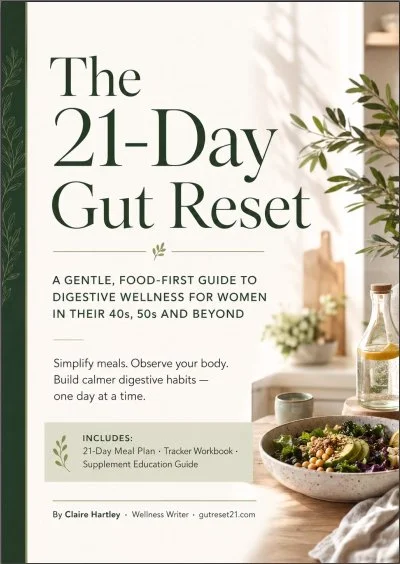
The 21-Day Gut Reset is a digital wellness guide I wrote for a gap I kept running into while researching this topic. Almost everything published for people with everyday digestive discomfort is either too clinical to follow outside a consultation, or so vague it amounts to "eat more fibre". There was very little in between.
It is structured around a simple three-phase approach: Simplify (week one), Rebuild with gut-friendly foods (week two), and Personalise based on your own observations (week three). The guide is delivered as a PDF and is designed to be read in stages rather than all at once.
This is not a medical programme, and nothing in it promises to cure, treat or reverse a condition. What it offers is a framework for paying structured attention to how food affects your body.
What's included — the full bundle
At US$12.99 you receive four separate PDFs:
| Item | What it covers | Pages (approx.) |
|---|---|---|
| The 21-Day Gut Reset (main guide) | 10 chapters covering the food-first philosophy, all three weeks, lifestyle factors, and when to seek professional help | ~70 pages |
| Bonus 1: Complete 21-Day Meal Plan | Day-by-day meals for all three weeks with shopping list, vegetarian swaps, dairy-free notes | ~25 pages |
| Bonus 2: 21-Day Tracker Workbook | Daily diary pages, weekly reflections, personal food map, and symptom tracker — printable | ~35 pages |
| Bonus 3: Supplement Education Guide | Plain-English overview of gut-related supplements (probiotics, fibre, enzymes, magnesium). No recommendations — educational only | ~18 pages |
Everything is available as an immediate digital download after purchase through Digistore24.
Who is this guide for?
I wrote this for adults, particularly women in their 40s, 50s and beyond, who notice digestive discomfort after meals but have no diagnosed condition under a specialist's care. The guide suits people who:
- Often feel heavy, sluggish, or uncomfortable after eating
- Want a structured plan rather than vague advice
- Prefer a food-first approach over supplements or restrictions
- Are willing to keep a simple daily diary
- Want to understand what works for their own body specifically
Anyone managing IBS, coeliac disease, Crohn's or another diagnosed digestive condition should speak to a healthcare professional before starting. This is educational material, not clinical care, and it should never take the place of the latter.
What works well
Having built the framework and revised it over 18 months against reader questions and the published guidance, here is what I think holds up:
✓ What works well
- + Three-phase structure is realistic rather than overwhelming
- + Meal plan uses ordinary supermarket ingredients (AU, UK, CA, US)
- + Tracker workbook is the most valuable single tool: patterns emerge that guessing never reveals
- + Supplement guide is genuinely cautious, with no affiliate links and no brand recommendations
- + Health disclaimers are clear and consistent throughout
- + Vegetarian and dairy-free swaps included throughout the meal plan
- + Week 3 personalisation is where the real insight comes, via the 48–72 hour reintroduction method
⚑ What to be aware of
- — No video or audio, entirely text-based PDFs
- — Week 3 requires patience: only 2–3 foods can be tested in 7 days
- — The tracker workbook works best printed and is fiddly on a screen
- — Does not address diagnosed conditions, so see a doctor first if symptoms are severe
- — Results depend entirely on consistency; this is not passive reading material
Is the underlying approach backed by anything?
The food-first structure was not invented here. Two pieces of it come from published work you can go and read yourself.
The first is the elimination-and-reintroduction method used in Week 3. It is a simplified version of the low-FODMAP protocol developed at Monash University, which is the reference base most dietitians work from. Monash runs it in three phases with a clinician supervising, and their own guidance is explicit that the restriction phase should not be open-ended. What this guide borrows is the reintroduction logic, one food group at a time over 48 to 72 hours, without the restriction phase. The second is the food and symptom diary in the tracker workbook, which is the same tool the NHS and the British Dietetic Association ask people to keep before any dietary change is assessed.
Two honest limits on that. Neither source was studying this guide, and neither endorses it. And the evidence they rest on is largely for diagnosed IBS under supervision, which is not the reader this guide is for. What that borrowing buys you is a structure with a real basis instead of one invented for a sales page. It is not evidence that the 21 days will work for you.
Who this is genuinely for: adults with everyday digestive discomfort who want a structured, food-first starting point. Who should see a doctor instead: anyone with a diagnosed digestive condition, anyone pregnant, or anyone whose symptoms are severe, sudden, or worsening.
Is it worth US$12.99?
The honest answer
Yes — if you follow it. The bundle contains approximately 148 pages of structured, practical content across four documents. The tracker workbook alone, if used daily for 21 days, will generate personal insight about your own digestion that no generic guide can replicate.
The price is reasonable for what is included. Cheaper things exist and so do far more expensive ones. What distinguishes this bundle is that it was written to be used rather than read once and forgotten.
Skip it if what you want is a quick fix, a medical treatment or a passive read. The guide asks for commitment. Five minutes on the diary each evening is the floor, and below that floor it delivers nothing.
For the right reader, someone frustrated with vague advice, willing to pay attention for 21 days and not managing a diagnosed condition, I think it is a fair exchange.
Ready to try it?
Instant digital download — all four PDFs delivered immediately after purchase.
Get the 21-Day Gut Reset — US$12.99Secure checkout via Digistore24. See refund policy before purchasing.
Related guides
How this guide was built
Nobody here ran a clinical trial, so it is worth being plain about where the material actually comes from. The 21-Day Gut Reset was assembled over roughly eighteen months from three sources, and each one is public.
- The three-week structure and the reintroduction method are a simplified version of the low-FODMAP protocol developed at Monash University, which is the reference base most dietitians work from. Monash runs it under supervision and is explicit that the restriction phase should not be open-ended. This guide borrows only the reintroduction logic, one food group at a time over 48 to 72 hours.
- The food and symptom diary in the tracker workbook is the same tool the NHS and the British Dietetic Association ask people to keep before any dietary change is assessed.
- The meal plan is the ordinary-supermarket version of those principles, checked against what is actually stocked in Australia, the UK, Canada and the United States.
What that does not buy you. None of those bodies studied this guide and none of them endorse it. The evidence they rest on is largely for diagnosed IBS under clinical supervision, which is not the reader this guide is written for. What the borrowing gives you is a structure with a real basis behind it rather than one invented for a sales page. It is not evidence that twenty-one days will work for you.
What we do not do. We publish no customer testimonials, because we do not yet have a set we could verify. We use no countdown timers and no invented scarcity: the price has been US$12.99 since launch. We take no commission from any supplement brand, and the supplement chapter recommends none.
Written by Claire Hartley. Last reviewed 29 July 2026. When the underlying guidance changes, this page changes with it.